For these two its better to visualise it (as with most things with circular functions)
Now remember that mods around the whole function will make everything that is negative, positive and leave the positive bits positive. i.e. Flip all the negative parts in the x-axis, and for mods inside the function like the second case it will flip the function for x>0 in the y-axis, retaining the original but making it like an even function.
Remembering that the mod in the case of |sin(x)| will flip everything that is below the x-axis, above it, i.e. make everything that is negative positive. Then we will have sin(x) when sin(x)>0 and -sin(x) when sin(x)<0.
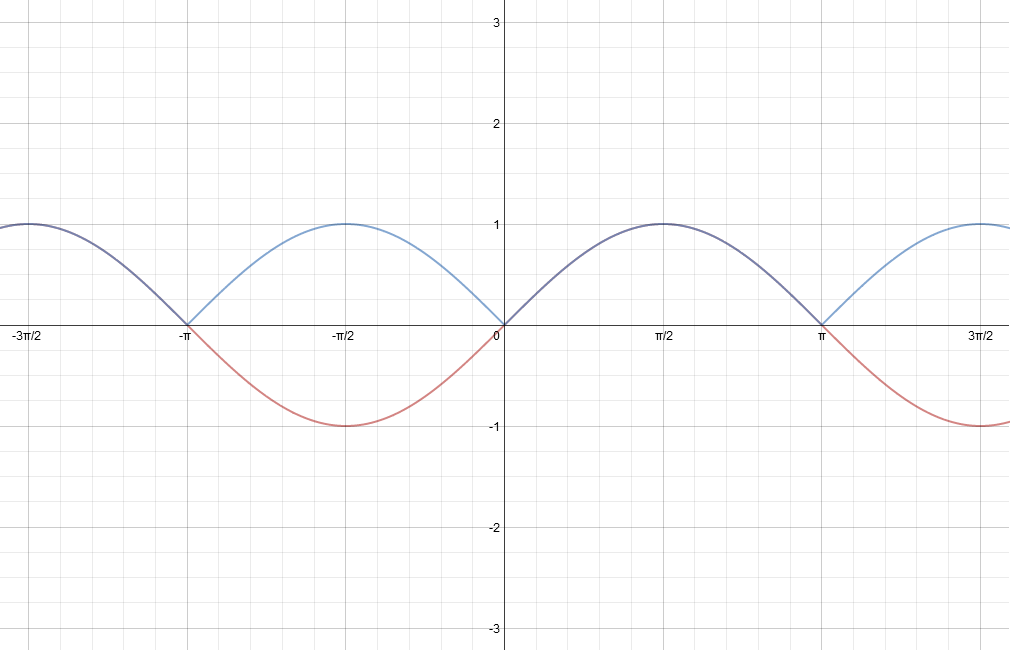
(RED is the original and BLUE is including the mod)
So sin(x)<0 for

e.t.c
So for domain of the y=sin(x) part you could say along the lines of
,2\pi(k+1)])
where

and adjust it for the y=-sin(x) part.
For sin|x|, its just going to flip the function in the y-axis, i.e. the part of the function of sin(x) for x0 will be copied and flipped for x<0.
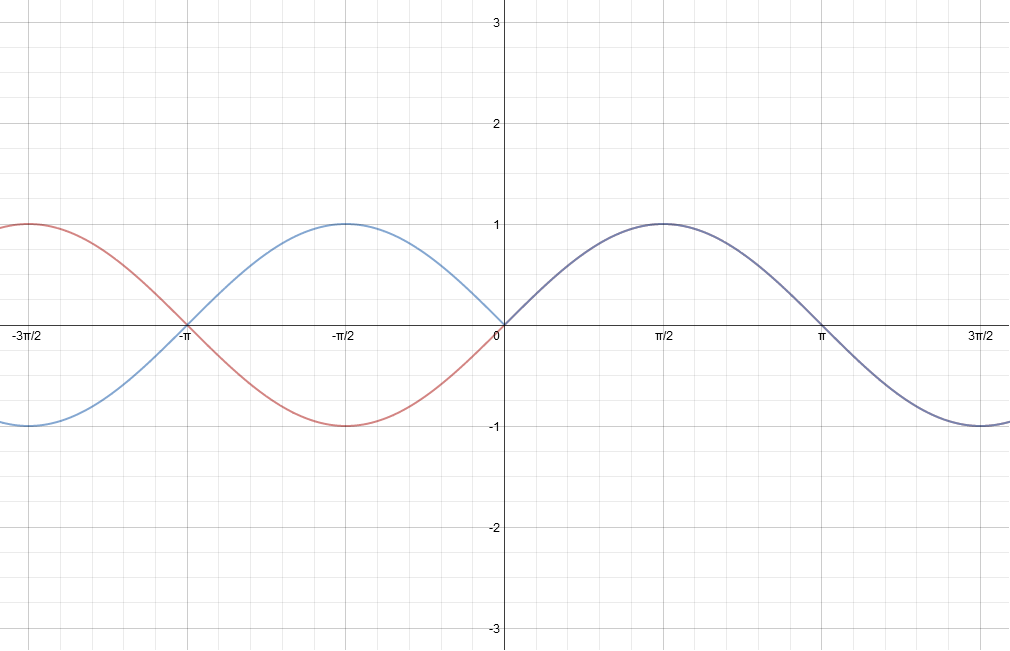
(RED is the original and BLUE is including the mod)
So remember that for x<0, whatever is in the mod will be made negative, so for x<0 sin|x|=sin(-x)=-sin(x). So you would get
 = \left\{ \begin{array}{rcl}<br />{sin(x)} & \mbox{for}<br />& x \geq 0 \\ -sin(x) & \mbox{for} & x<0<br />\end{array}\right.)
That wasn't such a great explanation with the domains of the first function, sorry about that but I hope it helps

EDIT: added a little bit at the start to try and explain it a bit better.
EDIT2: Fixed a couple of erros, changed R to N and a few other things.

 Home
Home
 Help
Help
 Search
 Login
Login
