Login

Welcome, Guest. Please login or register.

April 26, 2026, 07:04:44 pm

Author Topic: VCE Methods Question Thread!  (Read 6057647 times)  Share 

0 Members and 27 Guests are viewing this topic.

pi

  • Honorary Moderator
  • Great Wonder of ATAR Notes
  • *******
  • Posts: 14348
  • Doctor.
  • Respect: +2376
Re: VCE Methods Question Thread!
« Reply #495 on: April 04, 2012, 07:55:20 pm »
+1
Looks good to me :)

Phy124

  • Honorary Moderator
  • Part of the furniture
  • *******
  • Posts: 1354
  • Respect: +464
Re: VCE Methods Question Thread!
« Reply #496 on: April 04, 2012, 08:19:50 pm »
+1
a.) Show that the launch site is 2369km. Is it far north or far south of the equator?
Launch site will be where t = 0, so sub that into equation.

QUESTION 2
The height of a tidal wave approaching the face of the cliff on an island is represented by the equation
where h(t) is the height in metres, of the wave above the normal sea level t mins after the wave strikes the cliff.
d.) Normal sea level is 6 metres at the base of the cliff.

i.) For what values of 'h' would the sea bed be exposed?

ii.) How long, to the nearest tenth of a minutes, after the wave strikes the cliff does it take for the sea bed to be exposed

iii.) For how long, to the nearest tenth of a minute, is the sea bed exposed?
Firstly, just for b) you have the right answer so I assume you typed it up wrong, but just incase it should be:


d.) i.) This is a tad ambiguous but I'm going to go with; normal sea level is 6 metres at the base of the cliff, therefore when the height is less then 6 metres the sea bed will be exposed. <-- not entirely sure, though

ii.) The first point at which the height is less than 6 metres

iii.) Find two points at which the h(t) = 6 and find the time in between them (note this is for when the graph will below the two points)

b.) The authority decided to carry out simulation to determine if they had enought water to cope with a serious fire.

"If on Novermber 1, 2004, there is a serious fire which uses 300, 000 litres of water to bring under control, will the reservoir run dry if water rationing is not imposed?"

i.) Explain how to use the graph in a.) to solve the problem.


ii.) Will the reservoir run dry if water rationing is not imposed? If so, what month will this occur?
i.) You can use the said graph by inserting in values for the time at which events occur which will provide the amount of water present at the time.

ii.) Put in the corresponding value for t. If this value is less than 300,000 it will run dry before the fire is out, otherwise no.

Find a, b, and c

a = 3???

b =

c = 1???
As the radius is 3 metres, a = 3 (It would fluctuate between h and h - 6, therefore highest to lowest point is a difference of 6 and therefore the amplitude would be half this)

The centre of the rim has been moved up h - 3 from the bottom of the boat so c = h - 3
2011
Mathematical Methods | Physics | Chemistry | English | Business Management

2012-2017
Bachelor of Science in Applied Mathematics and Bachelor of Civil Engineering (Honours) @ Monash University

Current
Transport Modeller @ Arup

ashoni

  • Victorian
  • Trendsetter
  • **
  • Posts: 132
  • Respect: 0
  • School Grad Year: 2013
Re: VCE Methods Question Thread!
« Reply #497 on: April 04, 2012, 09:45:43 pm »
0
The complete factorisation of ap^3 +bq^3 is  8(2p-q)(4p^2+2pq+q^2). What are the values of a and b?

Phy124

  • Honorary Moderator
  • Part of the furniture
  • *******
  • Posts: 1354
  • Respect: +464
Re: VCE Methods Question Thread!
« Reply #498 on: April 04, 2012, 10:14:59 pm »
0
The complete factorisation of ap^3 +bq^3 is  8(2p-q)(4p^2+2pq+q^2). What are the values of a and b?


2011
Mathematical Methods | Physics | Chemistry | English | Business Management

2012-2017
Bachelor of Science in Applied Mathematics and Bachelor of Civil Engineering (Honours) @ Monash University

Current
Transport Modeller @ Arup

ashoni

  • Victorian
  • Trendsetter
  • **
  • Posts: 132
  • Respect: 0
  • School Grad Year: 2013
Re: VCE Methods Question Thread!
« Reply #499 on: April 08, 2012, 04:38:30 pm »
0
Thanks ~My♥Little♥Pony~! :D

Another question...
11. The polynomial P(x) = x^3-5/x^2+7x+k can be expressed in factor form with a repeated factor.
a. Let x=a be the double root of P(x) = 0 and x=b be the single root. Express P(x) in factor form.
b. By equating coefficients, construct equations involving a,b and k.
c. Find the value of k if P(x)= 0 and a and b are integers.

Show working when possible.. :)

TrueTears

  • TT
  • Honorary Moderator
  • Great Wonder of ATAR Notes
  • *******
  • Posts: 16363
  • Respect: +667
Re: VCE Methods Question Thread!
« Reply #500 on: April 08, 2012, 04:55:47 pm »
0
you mean P(x) = x^3-5x^2+7x+k?
PhD @ MIT (Economics).

Interested in asset pricing, econometrics, and social choice theory.

generalkorn12

  • Guest
Re: VCE Methods Question Thread!
« Reply #501 on: April 09, 2012, 01:30:55 pm »
0
Could anyone please explain how to sketch derivative graphs of Modulus functions?

Thanks. :)

Phy124

  • Honorary Moderator
  • Part of the furniture
  • *******
  • Posts: 1354
  • Respect: +464
Re: VCE Methods Question Thread!
« Reply #502 on: April 09, 2012, 02:39:19 pm »
+3
Could anyone please explain how to sketch derivative graphs of Modulus functions?

Thanks. :)


You would need to split the original modulus function into a piecewise or hybrid function and then you would be able to find a piecewise or hybrid function for the derivative graph, for example:


Therefore our derivative function will be given by:

2011
Mathematical Methods | Physics | Chemistry | English | Business Management

2012-2017
Bachelor of Science in Applied Mathematics and Bachelor of Civil Engineering (Honours) @ Monash University

Current
Transport Modeller @ Arup

generalkorn12

  • Guest
Re: VCE Methods Question Thread!
« Reply #503 on: April 09, 2012, 02:56:08 pm »
0
Ahhh, alrighty, now I get it. :) Thanks for that.

Adding on from that, how would you split, |sin(x)| or sin|x|, into hybrid  parts?

b^3

  • Honorary Moderator
  • ATAR Notes Legend
  • *******
  • Posts: 3529
  • Overloading, just don't do it.
  • Respect: +631
  • School: Western Suburbs Area
  • School Grad Year: 2011
Re: VCE Methods Question Thread!
« Reply #504 on: April 09, 2012, 03:43:11 pm »
+5
For these two its better to visualise it (as with most things with circular functions)

Now remember that mods around the whole function will make everything that is negative, positive and leave the positive bits positive. i.e. Flip all the negative parts in the x-axis, and for mods inside the function like the second case it will flip the function for x>0 in the y-axis, retaining the original but making it like an even function.

Remembering that the mod in the case of |sin(x)| will flip everything that is below the x-axis, above it, i.e. make everything that is negative positive. Then we will have sin(x) when sin(x)>0 and -sin(x) when sin(x)<0.
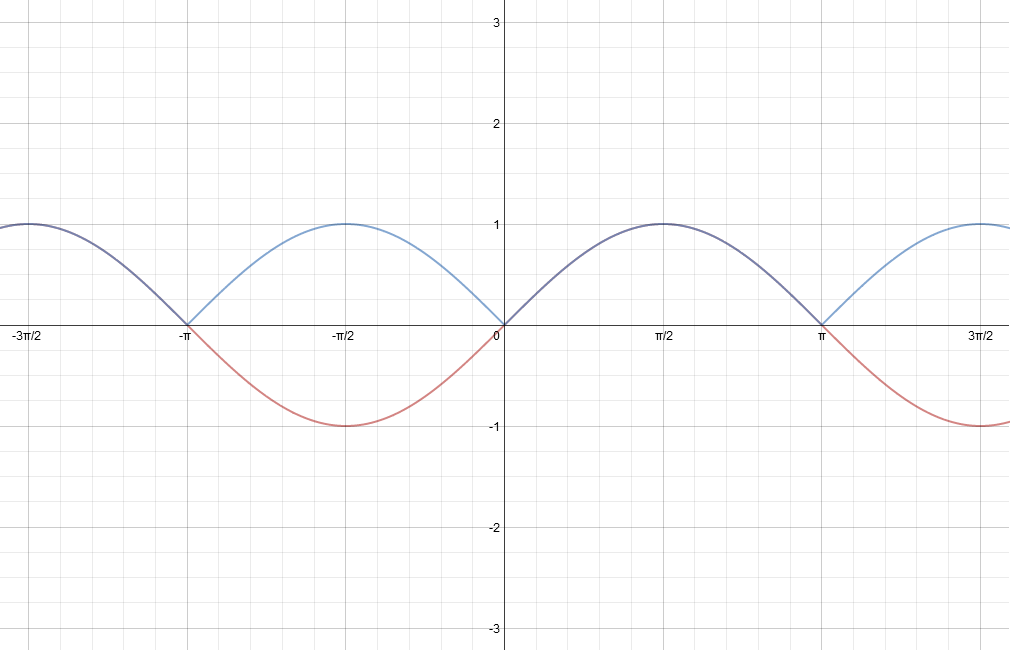
(RED is the original and BLUE is including the mod)
So sin(x)<0 for e.t.c
So for domain of the y=sin(x) part you could say along the lines of where and adjust it for the y=-sin(x) part.

For sin|x|, its just going to flip the function in the y-axis, i.e. the part of the function of sin(x) for x0 will be copied and flipped for x<0.
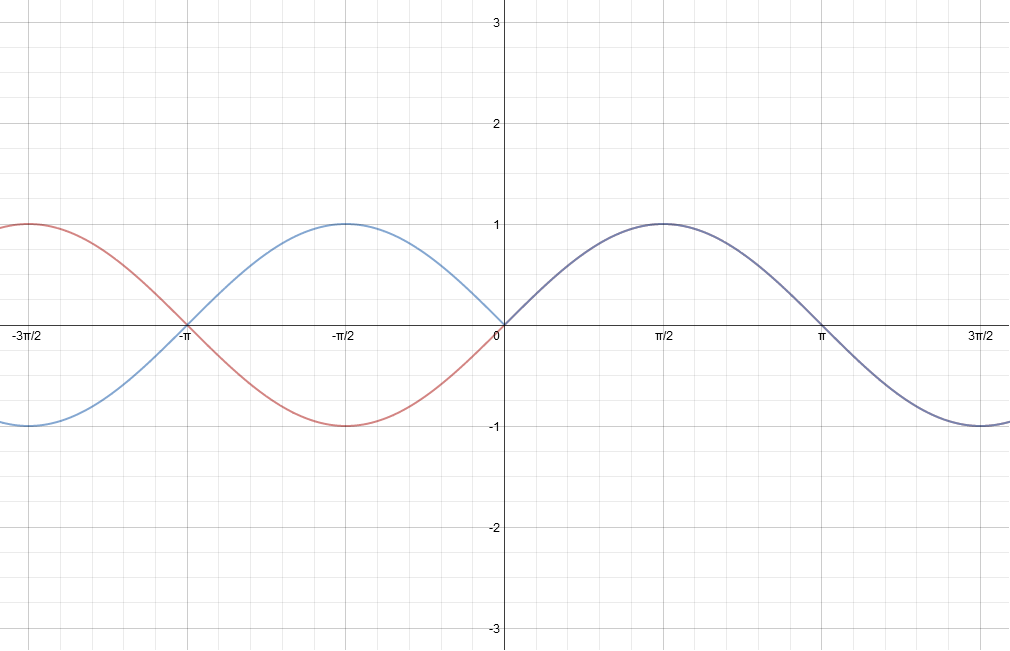
(RED is the original and BLUE is including the mod)
 
So remember that for x<0, whatever is in the mod will be made negative, so for x<0 sin|x|=sin(-x)=-sin(x). So you would get


That wasn't such a great explanation with the domains of the first function, sorry about that but I hope it helps :)

EDIT: added a little bit at the start to try and explain it a bit better.

EDIT2: Fixed a couple of erros, changed R to N and a few other things.

« Last Edit: July 30, 2012, 03:33:38 pm by b^3 »
2012-2016: Aerospace Engineering/Science (Double Major in Applied Mathematics - Monash Uni)
TI-NSPIRE GUIDES: METH, SPESH

Co-Authored AtarNotes' Maths Study Guides


I'm starting to get too old for this... May be on here or irc from time to time.

generalkorn12

  • Guest
Re: VCE Methods Question Thread!
« Reply #505 on: April 09, 2012, 04:05:59 pm »
0
Ahh, that's a great explanation! I can finally see how hybrid functions work with Trigs and absolute derivatives.

Thanks a lot b^3 and Moi Little Pony!! ;)
« Last Edit: April 09, 2012, 04:45:17 pm by generalkorn12 »

ashoni

  • Victorian
  • Trendsetter
  • **
  • Posts: 132
  • Respect: 0
  • School Grad Year: 2013
Re: VCE Methods Question Thread!
« Reply #506 on: April 10, 2012, 06:10:51 pm »
0

Mr. Study

  • Victorian
  • Forum Obsessive
  • ***
  • Posts: 494
  • Onion Knight
  • Respect: +18
Re: VCE Methods Question Thread!
« Reply #507 on: April 10, 2012, 06:16:49 pm »
0
Just this quicky question on differentiation.

Temperature in body, at time , is given by: T-40e^(-0.36t) + 20

Find rate of change of termperature with respect to time. (In terms of t)
I got the answer as dT/dt=-14.4e^(-0.36t)

[c]Find rate of change of termperature with respect to time. (In terms of T)

Honestly, I thought it'll be dt/dT but I realised that'll make it change in time with respect to temperature whereas the question wants change of temperature with respect to time.

I was thinking of tranposing to make T the subject but I am not too sure how I will set it out or what I will label the stuff as, and on top of that, If I did transpose and I were to differentiate the new function, it'll make it change in time with respect to temperature. >.>

Any help is appreciated
ᕕ( ᐛ )ᕗ

TrueTears

  • TT
  • Honorary Moderator
  • Great Wonder of ATAR Notes
  • *******
  • Posts: 16363
  • Respect: +667
Re: VCE Methods Question Thread!
« Reply #508 on: April 10, 2012, 06:21:14 pm »
0
Thanks ~My♥Little♥Pony~! :D

Another question...
11. The polynomial P(x) = x^3-5/x^2+7x+k can be expressed in factor form with a repeated factor.
a. Let x=a be the double root of P(x) = 0 and x=b be the single root. Express P(x) in factor form.
b. By equating coefficients, construct equations involving a,b and k.
c. Find the value of k if P(x)= 0 and a and b are integers.

Show working when possible.. :)
kk, for a) we have P(x) = c(x-a)^2(x-b)  where c is just a constant, however since we're dealing with a monic polynomial here [ie, the coefficient of the leading term of P(x) is 1] then c = 1, so P(x) = (x-a)^2(x-b)

b) expand (x-a)^2(x-b) into a cubic then equate the coefficients in front of x^3, x^2, x^1 and x^0.

c) just solve the equations in b) with the restriction that a and b are integers.
PhD @ MIT (Economics).

Interested in asset pricing, econometrics, and social choice theory.

kamil9876

  • Victorian
  • Part of the furniture
  • *****
  • Posts: 1943
  • Respect: +109
Re: VCE Methods Question Thread!
« Reply #509 on: April 10, 2012, 06:25:33 pm »
+4
Yeah in general just try to make the subject, but there is a shortcut that you could use here:

(can't be bothered with the exact constants)

(1)

 The derivative is so just plug in (1) to get it in terms of .
Voltaire: "There is an astonishing imagination even in the science of mathematics ... We repeat, there is far more imagination in the head of Archimedes than in that of Homer."