Hi guys, got 2 questions I need help on http://m.imgur.com/a/6JhU7
For the first image, is anyone else not getting what the answer has when using a Ti-Nspire? I'm getting x = -(k-mx-4) / 2(m-2) and y = k-mx / 2. I get what the answer has with my classpad but I plan on using the Ti in the exam.
It works fine for me.Try inserting multiplication signs in front of every coefficient of x and y.
Personally I hate the book's method and would rather equate the gradient of both equations in order to calculate when they are both equal.
My approach:
x +2 \space [1] \\ y = \frac{-mx+k}{2} \space [2])
 = \frac{-m}{2} \\ 2m - 4 = m \\ \therefore m = 4)
So now we know that there are
either no solutions or infinitely many solutions when m = 4.
a) \(m \space \epsilon \space \mathbb{R} \text { \ {4}} \) and \( k \space \epsilon \space \mathbb{R} \)
b) \( c_1 = c_2 \\ \frac{k}{2} = 2 \\ \therefore k = 4 \) However the question says to work out the value(s) of m and k, when there would be no solutions. Which means \( m_1 = m_2 \space \text{and} \space c_1 \neq c_2 \)
Therefore m = 4 and \( k \neq 4\)
c) The two equations must be a scalar multiple of one another. Therefore \( m_1 = m_2 \space \text{and} \space c_1 = c_2\)
m = 4 and k = 4
For Q5, I don't quite understand the alternative method shown using matrices. More specifically lines 2 and 3. In line 2 how'd they get that matrix and why is it equal to 0. For line 3, how'd they get 15 - 2m - m^2?
I would suggest looking at cramer's rule.
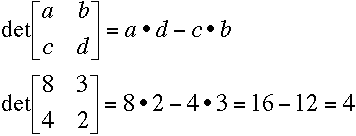
Line 2 : [Seems like they made a mistake. Row 2, column 2 must be 5] They have let it equal to zero, in order to work out the determinant of the matrix. A determinant of 0 corresponds to parallel lines (with either infinitely many solutions or no solutions), and a non-invertible matrix.
In line 3: they have worked out the determinant of the matrix.

 Home
Home
 Help
Help
 Search
 Login
Login
