^ Yep vegemite has provided the resonance structures.
I'll give you a step guide to draw out lewis structures
1) Calculate the no. of valence electrons* Note, don't forget to take into account the charge, i.e. For every + charge in the molecule, there's 1 less valence electrons, vice versa with -ve charges.
So in this example we have O3
No. valence electrons = 6*3 =
18 electrons2) Draw central atom with other atoms connected by single bonds*Usually the central atom would be the least electronegative atom.
In this case, it would just be any oxygen in the middle.
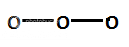 3) Complete octets of outer atoms
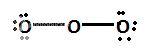 4) Add up electrons used
So far we have used 16 electrons (each bond counts for 2 electrons as well)
5) All electrons used up?If yes, move to 6
If no, use the remainder of your electrons to complete the octet of central atom
So we haven't used up all our electrons, we have 18 available and used up 16, add 2 electrons to the central atom.
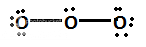 6) Move electrons from outer atoms to complete octet of central atom by converting them to bonds
Don't forget to check your charges and that it makes logical sense (+ and - cancel out to 0)
So as we see there are 2 resonance structures. In this case they are equivalent contributing structures to the hybrid which I've shown below
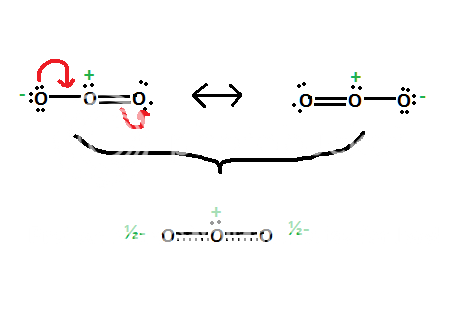
Basically what resonance structures tell you is that 50% of the time it will assume the structure on the left, and the other 50% of the time it assumes the structure on the right.
The hybrid resembles this and says that the overall charge of each outer oxygen will be -1/2, and the central atom still retains its full positive charge.
The dotted + solid bonds resemble the bond O-O is halfway between a single bond and a double bond (so 1.5 bonds basically).
Just to note, you do not need to know how to draw resonance hybrid, or the mechanisms (the arrows). This will never be examined in VCE chemistry, but it's just for interest sake.

 Home
Home
 Help
Help
 Search
 Login
Login
