So I'm near the completion of the Graphs and Relations module when I came across a linear programming application question (one of those blending/manufacturing/transportation problems) but the corner points of the feasible region were not integers. The textbook explains how to evaluate these problems but then states:
This is beyond the scope of Further Mathematics.
In confusion, I checked the study design which merely states the following:
• the use of graphical methods to solve simple linear programming problems with two decision variables, such as blending and manufacturing problems.
The questions are quite challenging and I highly doubt that many students across the state would be able to do them. Is it a possibility that they could throw in one of these questions in the exams to determine which students will receive a 50?
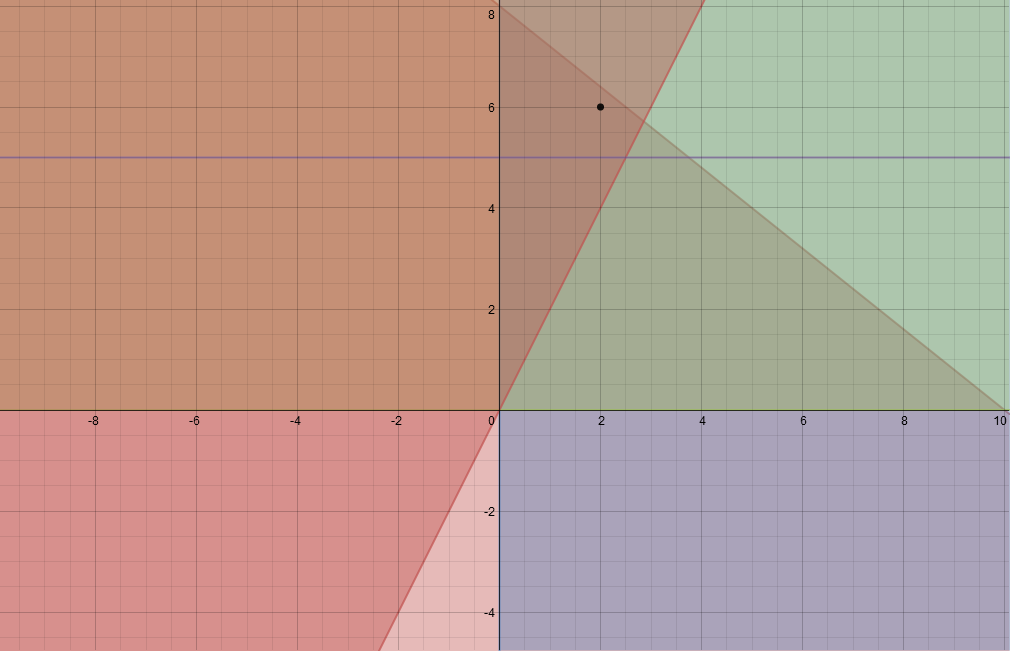
It depends on the context of the question, IIRC on an exam (I think it was VCAA, not 100% sure though) a couple of years ago that invovled the number of dogs, and the best point was something like 4.5 dogs. You couldn't use this as you couldn't physically have four and a half dogs, but you had to check that they way you rounded still fitted in the feasible region and that it was still the maximum or minimum or w/e the question was asking for. So you can get feasible regions with the corner points not being integers, if its a number of items, then you can't split them in half, so you would have to take the best whole point that fitted in the region. Sometimes this meant checking every close to corner point (the integer points) in the region (depending on the question, but I'm a bit hazy on further....).
So yes they may, just be aware of it
 EDIT:
EDIT: I think I've found the question, VCAA Exam 2 Q3 -
http://www.vcaa.vic.edu.au/vce/studies/mathematics/further/pastexams/2006/2006furmath2-w.pdfAnd the assesors report -
http://www.vcaa.vic.edu.au/vce/studies/mathematics/further/assessreports/2006/furthermaths2_assessrep_06.pdfAs you can see the vertex's aren't integers, and we can't have half or a third of a dog.
Have a look through it, and you'll see what I mean
The associated region is below

 Home
Home
 Help
Help
 Search
 Login
Login
