Login

Welcome, Guest. Please login or register.

April 26, 2026, 09:43:43 pm

Author Topic: Linear Approximations  (Read 5403 times)  Share 

0 Members and 1 Guest are viewing this topic.

Will Sparks

  • .
  • Trendsetter
  • *
  • Posts: 116
  • Relax mate. VCE isn't EVERYTHING.
  • Respect: -5
  • School: Summer Heights High
  • School Grad Year: 2013
Linear Approximations
« on: May 30, 2013, 07:19:43 pm »
0
Hey guys, I'm having trouble with understanding linear approximations along with these questions.

All I've been doing is using f(x+h) = hF'(x) + f(x) and that hF'(x) represents the increase and also that h must be a small value.
(By the way, the equals sign is also shown as a squigly line on top of a straight line, is that always necessary?)

I don't actually understand why or how or anything else at the moment, all I've been doing is subbing in values and occasionally getting them right.


Here's a few questions that I'm struggling with.

1) Use Calculus to find an approximation of 65^1/3 (I.e. cube root of 65)

2) Find the percentage change in the volume of a sphere (V = 4πr^3 / 3) if there is a 3% change in radius of the sphere.


Thanks in advance.

Spoiler
Answers: 4.028, 9% change in V
English [14] Methods [19] Specialist [16] Chemistry [15] Physics [18]

ATAR: 33.60


You do realize that in order for us to get ATARs of 80-90+, there has to be people at the other end of the spectrum right?

BubbleWrapMan

  • Teacher
  • Part of the furniture
  • *
  • Posts: 1110
  • Respect: +97
Re: Linear Approximations
« Reply #1 on: May 30, 2013, 07:35:04 pm »
+2
1) Basically a matter of determining what to call and . Here we know the cube root of 64, so we can use this value and since we're changing '' by 1. would be the cube root function, from which you can find .

This should give you .

2) Just replace with , then factor out the 1.03, which should give you approximately , so there's a 9% increase.
Tim Koussas -- Co-author of ExamPro Mathematical Methods and Specialist Mathematics Study Guides, editor for the Further Mathematics Study Guide.

Current PhD student at La Trobe University.

Will Sparks

  • .
  • Trendsetter
  • *
  • Posts: 116
  • Relax mate. VCE isn't EVERYTHING.
  • Respect: -5
  • School: Summer Heights High
  • School Grad Year: 2013
Re: Linear Approximations
« Reply #2 on: May 30, 2013, 07:56:10 pm »
0
1) Basically a matter of determining what to call and . Here we know the cube root of 64, so we can use this value and since we're changing '' by 1. would be the cube root function, from which you can find .

This should give you .

2) Just replace with , then factor out the 1.03, which should give you approximately , so there's a 9% increase.

Ah I understand the first part but I still don't understand the second part.

What would the h value be in this case? I don't really get what you mean by factoring the 1.03 out.
English [14] Methods [19] Specialist [16] Chemistry [15] Physics [18]

ATAR: 33.60


You do realize that in order for us to get ATARs of 80-90+, there has to be people at the other end of the spectrum right?

BubbleWrapMan

  • Teacher
  • Part of the furniture
  • *
  • Posts: 1110
  • Respect: +97
Re: Linear Approximations
« Reply #3 on: May 30, 2013, 07:59:02 pm »
+1
It's not even linear approximation. I just did .
Tim Koussas -- Co-author of ExamPro Mathematical Methods and Specialist Mathematics Study Guides, editor for the Further Mathematics Study Guide.

Current PhD student at La Trobe University.

Will Sparks

  • .
  • Trendsetter
  • *
  • Posts: 116
  • Relax mate. VCE isn't EVERYTHING.
  • Respect: -5
  • School: Summer Heights High
  • School Grad Year: 2013
Re: Linear Approximations
« Reply #4 on: May 30, 2013, 08:02:02 pm »
0
It's not even linear approximation. I just did .

Ah I see, I guess it's like using the double derivative in methods ahaha, I actually understand your way but it won't be what the assessors are looking for.

Well I guess I'll go ask my methods teacher for help tomorrow thanks for the help Timmeh :)
English [14] Methods [19] Specialist [16] Chemistry [15] Physics [18]

ATAR: 33.60


You do realize that in order for us to get ATARs of 80-90+, there has to be people at the other end of the spectrum right?

Professor Polonsky

  • Victorian
  • Part of the furniture
  • *****
  • Posts: 1169
  • Respect: +118
  • School Grad Year: 2013
Re: Linear Approximations
« Reply #5 on: May 30, 2013, 08:09:28 pm »
0
There is nothing wrong with doing it that way in Methods. That's exactly how I would do it.

If you wanted to, you could use and calculate the linear approximation for .
« Last Edit: May 30, 2013, 08:11:18 pm by Polonius »

BubbleWrapMan

  • Teacher
  • Part of the furniture
  • *
  • Posts: 1110
  • Respect: +97
Re: Linear Approximations
« Reply #6 on: May 30, 2013, 08:10:20 pm »
+1
I guess would be , which you'd substitute into which gives you the approximate percentage change according to Essentials, though this never comes up on exams, since it's not on the study design.
Tim Koussas -- Co-author of ExamPro Mathematical Methods and Specialist Mathematics Study Guides, editor for the Further Mathematics Study Guide.

Current PhD student at La Trobe University.

brightsky

  • Victorian
  • ATAR Notes Legend
  • *******
  • Posts: 3136
  • Respect: +200
Re: Linear Approximations
« Reply #7 on: May 30, 2013, 08:28:21 pm »
+7
yeah linear approximation can be quite tough to get your head around at first, but after you understand underlying principles, the topic becomes quite manageable and straightforward.

consider the following diagram (it's not a particularly good one, but it's the only one i could find).
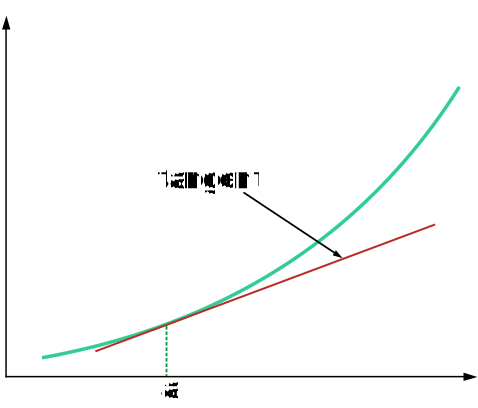


suppose the equation of the curve is y=f(x). you are given f(a) (that is the y-value at x=a) and f'(a) (that is the gradient at x=a). now say you want to find the value of f(a+h) (that is the y-value at x=a+h, where h is small). in this case, you can simply substitute x=a+h into the supplied equation y=f(x) and obtain an exact value. however, it is not always possible to obtain the equation of y=f(x) (you'd appreciate this if you do spesh; for example, if you only know the derivative equation, i.e. dy/dx=f'(x), then it is not always possible to integrate both sides to obtain the equation y=f(x), since there is only a limited number of expressions that can be integrated). so sometimes, we can only find an APPROXIMATION for f(a+h).

so, what is the best approximation given the data we have at hand? (remember, we only know f(a) and f'(a)). well, how about if we draw in the tangent at x=a, and then locate the point on the tangent at x=a+h and find the y-value of THAT instead? if h is small, say 0.01, then we would be able to obtain a pretty decent approximation (the y-value of the point on the tangent at x=a+h - the approximation - would pretty much be equal to the y-value of the point on the curve at x=a+h - the real value). so the question is: what is the y-value of the point on the tangent at x=a+h?

well, we know from year 9 maths how to find the equation of the tangent at x=a:

y-f(a) = f'(a) (x-a)

[notice that we CAN find the equation of the tangent because we know f(a) and f'(a), and these are the only two pieces of information required.]

so at x=a+h:

y - f(a) = f'(a) ((a+h)-a)
y - f(a) = h*f'(a)
y = f(a) + h*f'(a)

look familiar? yes, this is the formula for linear approximation. but don't just memorise this formula without understand what it actually represents.

now, suppose we knew f'(a+h/3), f'(a+2h/3), as well as f'(a+h). can we not obtain an even better approximation? have a think about this...not really needed in methods but it is in the spesh course. (search up euler's method if interested or better yet just sit down and think about how the new data can be exploited yourself.)

new problem. suppose we knew, not only f(a) and f'(a), but also f''(a), f'''(a), f''''(a) (fourth derivative) and so on. can we exploit this new data to obtain an even better approximation. how about if we knew ALL the derivatives? the fifth derivative at x=a, the sixth, the seventh, ...the a millionth! perhaps we can obtain SO accurate an approximation that the approx actually COINCIDES with the actual value. (search up taylor series if interested.)

2020 - 2021: Master of Public Health, The University of Sydney
2017 - 2020: Doctor of Medicine, The University of Melbourne
2014 - 2016: Bachelor of Biomedicine, The University of Melbourne
2013 ATAR: 99.95

Currently selling copies of the VCE Chinese Exam Revision Book and UMEP Maths Exam Revision Book, and accepting students for Maths Methods and Specialist Maths Tutoring in 2020!

Will Sparks

  • .
  • Trendsetter
  • *
  • Posts: 116
  • Relax mate. VCE isn't EVERYTHING.
  • Respect: -5
  • School: Summer Heights High
  • School Grad Year: 2013
Re: Linear Approximations
« Reply #8 on: May 30, 2013, 09:20:18 pm »
0
Holy shit bright sky thank you so much for that explanation.

And well, I do spesh as well, but I haven't encountered a derivative that I couldn't integrate on my calculator?


But apart from that wow, thank you SO much for that explanation. It makes so much more sense now.


But Timmeh, linear approximation isn't on the exam?!
English [14] Methods [19] Specialist [16] Chemistry [15] Physics [18]

ATAR: 33.60


You do realize that in order for us to get ATARs of 80-90+, there has to be people at the other end of the spectrum right?

brightsky

  • Victorian
  • ATAR Notes Legend
  • *******
  • Posts: 3136
  • Respect: +200
Re: Linear Approximations
« Reply #9 on: May 30, 2013, 09:26:36 pm »
+1
Holy shit bright sky thank you so much for that explanation.

And well, I do spesh as well, but I haven't encountered a derivative that I couldn't integrate on my calculator?


But apart from that wow, thank you SO much for that explanation. It makes so much more sense now.


But Timmeh, linear approximation isn't on the exam?!

there are heaps of first order differential equations that cannot be solved by hand (at least at spesh level), e.g. dy/dx = x*e^y/sin(x) [note that it is quite hard to express y in terms of x in this case].
2020 - 2021: Master of Public Health, The University of Sydney
2017 - 2020: Doctor of Medicine, The University of Melbourne
2014 - 2016: Bachelor of Biomedicine, The University of Melbourne
2013 ATAR: 99.95

Currently selling copies of the VCE Chinese Exam Revision Book and UMEP Maths Exam Revision Book, and accepting students for Maths Methods and Specialist Maths Tutoring in 2020!

BubbleWrapMan

  • Teacher
  • Part of the furniture
  • *
  • Posts: 1110
  • Respect: +97
Re: Linear Approximations
« Reply #10 on: May 30, 2013, 09:51:39 pm »
0
I meant percentage change wasn't on exams.

Also yeah I was waiting for someone to explain it with a diagram. :p Cheers brightsky.
Tim Koussas -- Co-author of ExamPro Mathematical Methods and Specialist Mathematics Study Guides, editor for the Further Mathematics Study Guide.

Current PhD student at La Trobe University.