Login

Welcome, Guest. Please login or register.

November 08, 2025, 04:06:05 am

Author Topic: NMR 13C and 1H  (Read 909 times)  Share 

0 Members and 1 Guest are viewing this topic.

mano91

  • Victorian
  • Trendsetter
  • **
  • Posts: 175
  • Respect: +3
  • School: Caroline Chisholm Catholic College
  • School Grad Year: 2009
NMR 13C and 1H
« on: May 31, 2009, 09:53:54 pm »
0
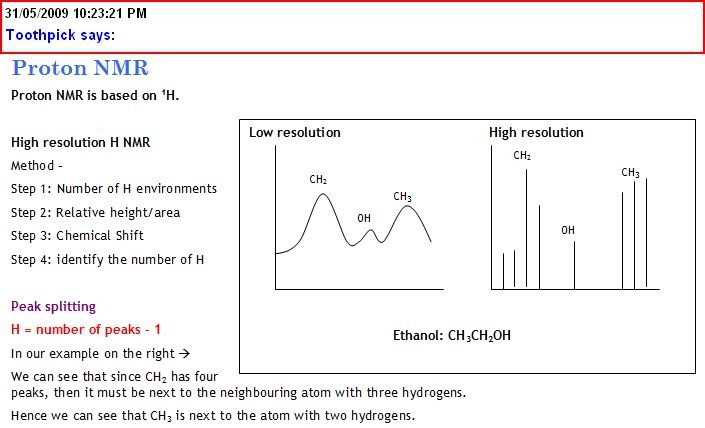
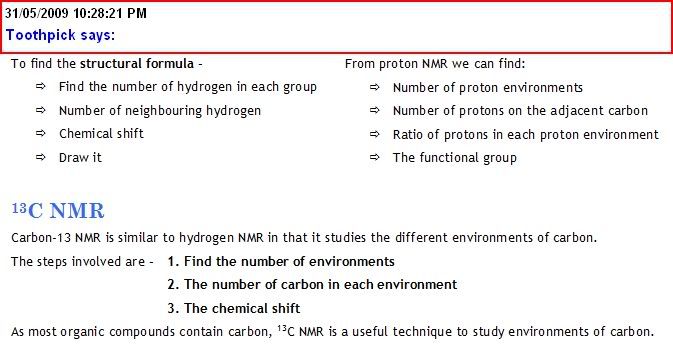
Can someone please go into lots of detail about determining H environments and C environments for each?
I wouldnt mind seeing lots of examples to help get the jist of it.
Also, the way to note the environments. for example, in ethanol, how would you write down wat the three environments are?
2008: Mathematical Methods (CAS) [36]
2009: English [34] Chemistry [37] Physics [34] Specialist Mathematics [39] Physical Education [24]
ENTER: 94.50
2010-2013: Bachelor of Engineering (Civil & Infrastructure)

d0minicz

  • Victorian
  • Forum Leader
  • ****
  • Posts: 997
  • Respect: +6
Re: NMR 13C and 1H
« Reply #1 on: May 31, 2009, 09:59:14 pm »
0
for ethanol ; the 3 H environments are due to CH3 , CH2, and OH
                                                                   3:      2    :      1
there are 2 carbon environments but they are the same height ; CH3 and CH2
                                                                                              1     :     1

Doctor of Medicine (UoM)

Toothpaste

  • pseudospastic
  • Victorian
  • Part of the furniture
  • *****
  • Posts: 1648
  • Member #10
  • Respect: +26
Re: NMR 13C and 1H
« Reply #2 on: May 31, 2009, 10:27:15 pm »
0

Note: the height of my lines on the high-res pic might not be accurate. (as in the height of the lines)
EDIT: oh shit forgot the zero shift. Pretend I drew it.


More Proton NMR examples

Example 1:

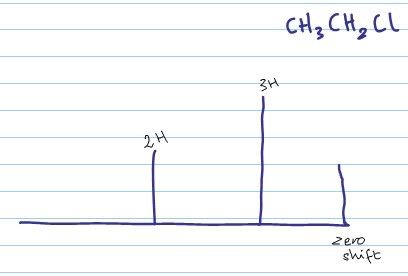
Low resolution:


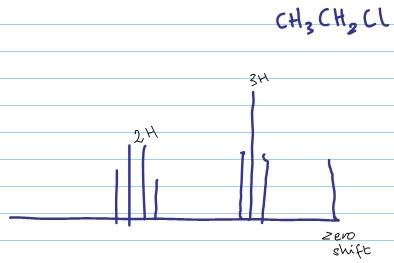
High resolution


From the above analysis:
- in , the 2H are in the same chemical environment which results in the same peak
- in , the 3H are in the same chemical environment which results in the same peak too

Look at the high res
- 's peak is split into 3 separate peaks. It is next to . (think of it as one peak for itself, 2 other peaks for 2H from )
- is split into 4 smaller peaks. This is because it's next to . (one peak for itself, 3 other peaks for 3H nextdoor).


Example 2
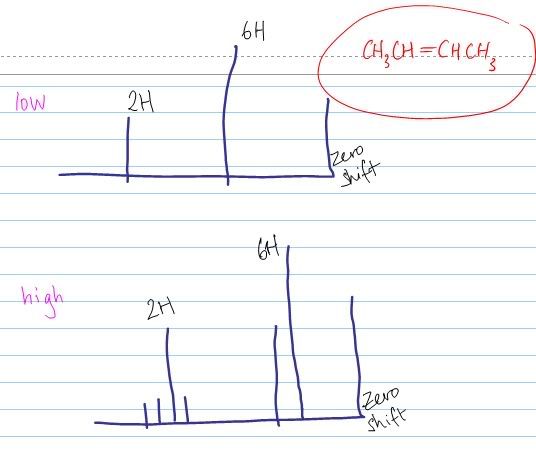

symmetry.
6H as in both environments, which are in the same chemical environment. (therefore turn out to be the same peak).
2H (both groups) are also in the same environment which results in the same peak.
In the high res, only half of the molecule's property is shown since one half of it is the same as the other (symmetry). [the peak heights increase though]

Anyway, sorry I'm tired, cbf C13 NMR examples. If you get H1 NMR you're pretty much able to understand carbon-13 NMR.

EDIT ONE YEAR LATER: just realised the intensities are meant to follow pascal's triangle if not affected by overlaps/goal post things or what-not... pretend they do. lalala

« Last Edit: May 26, 2010, 04:17:08 pm by Toothpaste »