Login

Welcome, Guest. Please login or register.

December 13, 2025, 08:38:24 am

Author Topic: VCAA 2011 exam 2 question  (Read 2032 times)  Share 

0 Members and 1 Guest are viewing this topic.

mano91

  • Victorian
  • Trendsetter
  • **
  • Posts: 175
  • Respect: +3
  • School: Caroline Chisholm Catholic College
  • School Grad Year: 2009
VCAA 2011 exam 2 question
« on: June 20, 2013, 10:33:48 pm »
0
http://www.vcaa.vic.edu.au/Documents/exams/mathematics/2011mmcas2-w.pdf

Question 3 extended response part b) i) and ii)

it says a cubic function- so how can there be 0,1, or 2 stationary points in part b)i) ??
are they implying that since a,b,c, and k are an element of R: that a and b can equal 0 and hence the cubic (turns into a linear) won't have stationary points??


also, if someone could explain 4 f) 
thanks
2008: Mathematical Methods (CAS) [36]
2009: English [34] Chemistry [37] Physics [34] Specialist Mathematics [39] Physical Education [24]
ENTER: 94.50
2010-2013: Bachelor of Engineering (Civil & Infrastructure)

lzxnl

  • Victorian
  • ATAR Notes Legend
  • *******
  • Posts: 3432
  • Respect: +215
Re: VCAA 2011 exam 2 question
« Reply #1 on: June 20, 2013, 10:44:46 pm »
+3
Well the derivative of a cubic function is a quadratic. Quadratics can have no roots (x^2+1=0), one root (x^2=0) or two roots (x^2=1). The nature of the derivative of a cubic determines how many stationary points it has.
An example of a cubic without stationary points is x^3+x. It just increases.

4f is evil. 1% of the state got this question right apparently. The way you solve this is through examining the derivative function. If you differentiate T, you have a term that depends on k. As k increases, this term decreases. Soon, if k is high enough, x=7/2 is where the derivative function is zero. If k goes past this number, then there is no stationary point. Furthermore, the derivative is always negative. This means that the right endpoint, x=7/2, becomes the minimum value in the domain. You just need to solve for when x=7/2 and dT/dx.

If you want a more explicit answer just tell me.
2012
Mathematical Methods (50) Chinese SL (45~52)

2013
English Language (50) Chemistry (50) Specialist Mathematics (49~54.9) Physics (49) UMEP Physics (96%) ATAR 99.95

2014-2016: University of Melbourne, Bachelor of Science, Diploma in Mathematical Sciences (Applied Maths)

2017-2018: Master of Science (Applied Mathematics)

2019-2024: PhD, MIT (Applied Mathematics)

Accepting students for VCE tutoring in Maths Methods, Specialist Maths and Physics! (and university maths/physics too) PM for more details

mano91

  • Victorian
  • Trendsetter
  • **
  • Posts: 175
  • Respect: +3
  • School: Caroline Chisholm Catholic College
  • School Grad Year: 2009
Re: VCAA 2011 exam 2 question
« Reply #2 on: June 20, 2013, 10:54:14 pm »
0
Thanks heaps!

I just wasn't switched on about 4b) i)...

I haven't had a good think about 4f, it's been a while since I attempted it (sometime last year) but I just remembered that I had trouble with it.

Again, thanks nliu1995!
2008: Mathematical Methods (CAS) [36]
2009: English [34] Chemistry [37] Physics [34] Specialist Mathematics [39] Physical Education [24]
ENTER: 94.50
2010-2013: Bachelor of Engineering (Civil & Infrastructure)

b^3

  • Honorary Moderator
  • ATAR Notes Legend
  • *******
  • Posts: 3529
  • Overloading, just don't do it.
  • Respect: +631
  • School: Western Suburbs Area
  • School Grad Year: 2011
Re: VCAA 2011 exam 2 question
« Reply #3 on: June 20, 2013, 10:57:39 pm »
0
EDIT: Bit late but oh well.

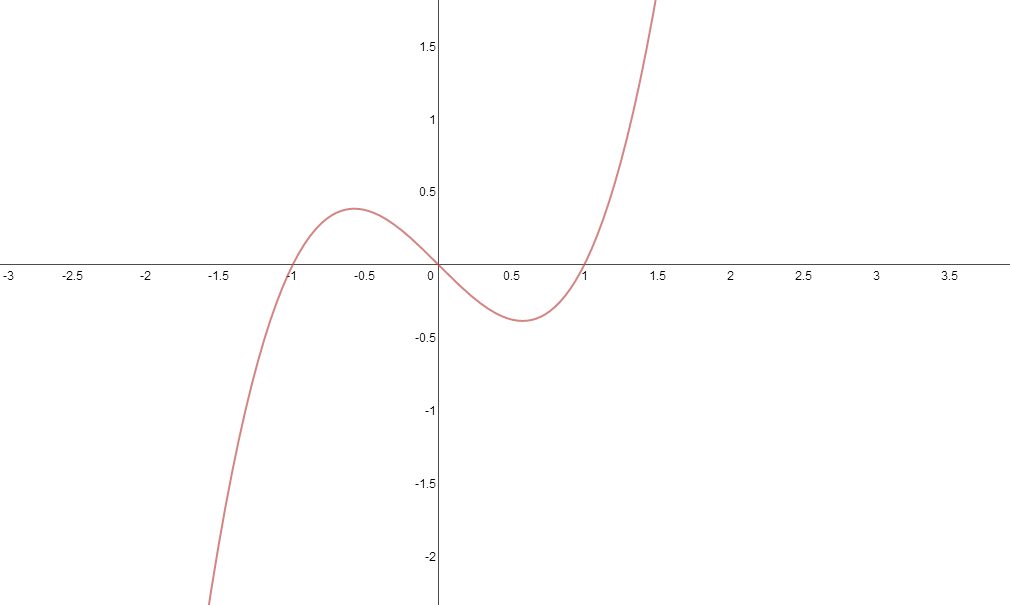
Just going to add to what nliu1995 has said above, as if may help to look at it visually. The cubic functions below have 0,1 and 2 stationary points.
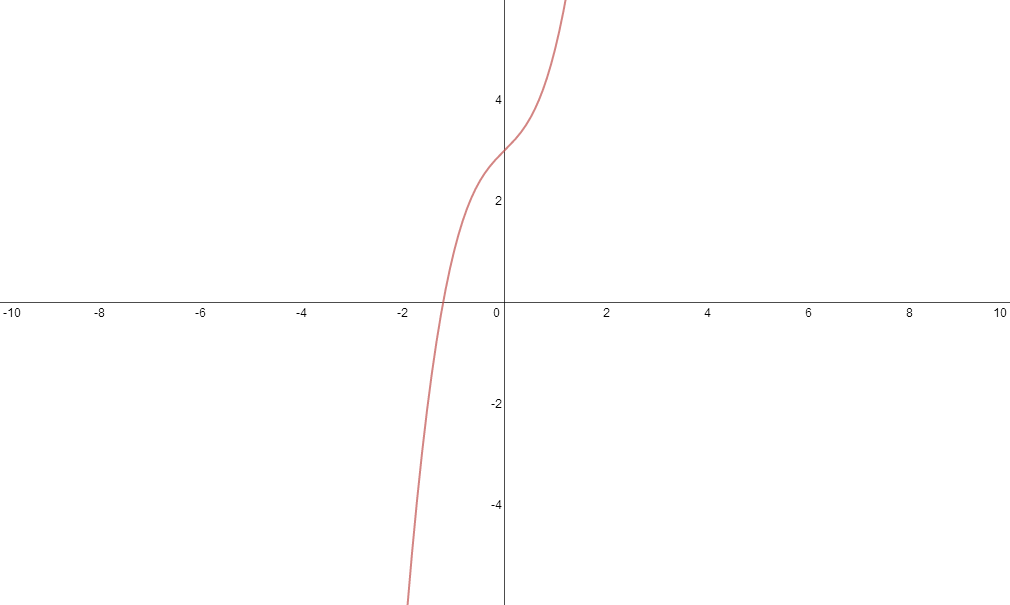
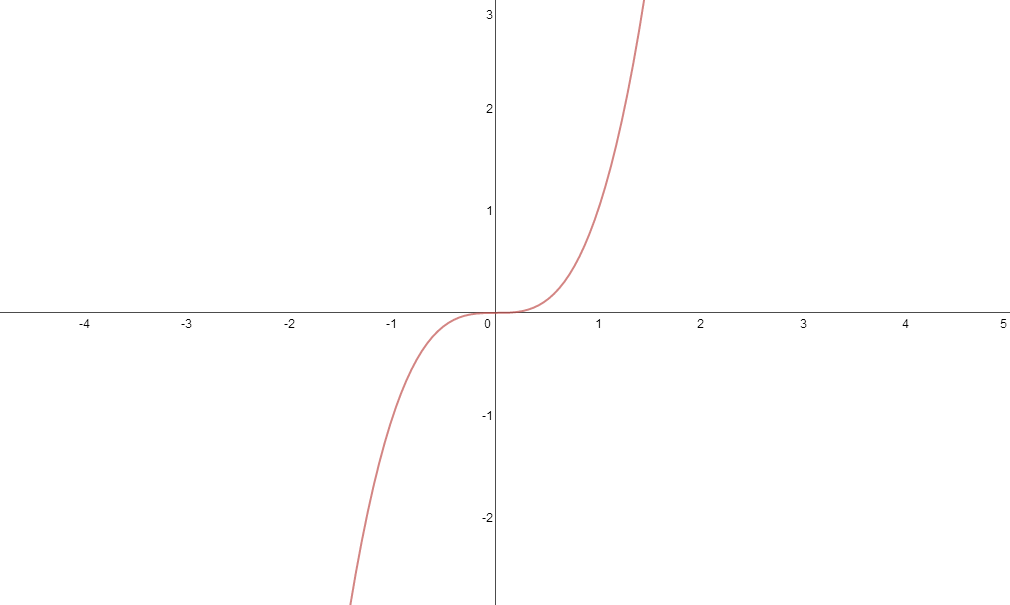
So as nliu1995 has said, if you differentiate the first, the quadratic you get will have 0 solutions, i.e. the discriminant will be less than 0.
If you differentiate the second, you will get a quadratic with a repeated root, that is only 1 unique solution, discriminant=0.
For the third, again differentiating will give a quadratic with two solutions, discriminant>0.

You don't need the above for the actual question, it's just more a way to look at it and think about it. The second point to note is that a cubic function with no stationary points (as in the first example) is not a linear function, it still has a non zero coefficient on , it's just the has no solutions, and so no turning points.

Anyways, hope that helps.

2012-2016: Aerospace Engineering/Science (Double Major in Applied Mathematics - Monash Uni)
TI-NSPIRE GUIDES: METH, SPESH

Co-Authored AtarNotes' Maths Study Guides


I'm starting to get too old for this... May be on here or irc from time to time.

Phy124

  • Honorary Moderator
  • Part of the furniture
  • *******
  • Posts: 1354
  • Respect: +464
Re: VCAA 2011 exam 2 question
« Reply #4 on: June 21, 2013, 05:00:41 pm »
0
Regarding question 4b); I think it is worth noting that it appears as though the exam writers deliberately structure questions such that the separate parts of a question may relate or give hints regarding the latter questions.

For this case in part a) we had been dealing with a cubic function that had a derivative function that was greater than 5 for all x.

We know that the gradient of a graph and hence its stationary points are directly related to its derivative. If the graph of f'(x) is greater than 5 for all x then it has no roots and hence the function that this is the derivative of, f(x), has no stationary points.

tldr; In addition to what has been said above, I believe that the exam writers specifically structure exams in such a way to give hints to students regarding follow up questions, as is the case here. Consequently I think students should pay attention to the structure and relations between specific parts of a question.

Also extra explanations for 4f:

if he goes directly from his camp at to the plant then since the coordinates of the plant is

the function that describes how long he takes to go from his camp to the plant is

the question requires that T is as small as possible, and since x is kept as a constant, only k can be varied. so, differentiating T and substituting gives thus, solving for k gives

k determines how fast he can swim. Big k-values means the time he spends swimming is really big, ie, swims slowly.
small k values means he doesnt spend much time swimming and so, he swims quickly.

recapping: big k values, slow swimmer, LESS SWIMMING MORE RUNNING
small k values, fast swimmier, MORE SWIMMING LESS RUNNING

we just found out, that if k=5root(37)/74, he should do ZERO swimming, so if k is even bigger, how much swimming should he do? even less than 0 kms of swimming, which he cant, so we just say he runs directly there for k=>5root(37)/74
2011
Mathematical Methods | Physics | Chemistry | English | Business Management

2012-2017
Bachelor of Science in Applied Mathematics and Bachelor of Civil Engineering (Honours) @ Monash University

Current
Transport Modeller @ Arup