Hey guys,
I'm answering the question to state the nature of the relation that exists for

Buuut in the solutions (which I've attached), I just don't understand the part which I've highlighted!
I don't understand where they got the 6 from or why they add  !
!
So confused 
Just wanted to introduce a rather nifty method to determine the Cartesian equation of an ellipse from the 'complex equation'.
First, consider how you would draw an ellipse at a beach if all you were given were two pegs, a rope and a stick. To begin, you would hammer the two pegs into the sand, making sure that they were more or less side by side at a fixed distance from each other. Then, you would tie the rope around the two pegs, grab the stick, drag the rope that is now secured at both ends to the two pegs upwards until the rope becomes taut, and move the stick around the two pegs in a circular fashion, ensuring the rope remains taut.
Now, let F_1 (-m,0) and F_2 (m,0) denote the positions of the two pegs. In the diagram below, the dotted line represents the rope, pulled taut by the stick, which is positioned at P (x,y).

Now, to obtain the full ellipse, we would take the stick positioned at P(x,y) and move it around F_1 and F_2 in a circular fashion.
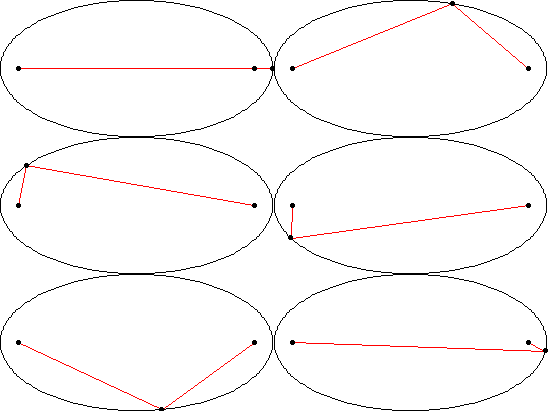
To understand the method of constructing an ellipse outlined above, acquaintance with the formal definition of an ellipse is required. Analytically, an ellipse may be defined as the set of all points P(x,y) such that PF_1 + PF_2 = k, where k is some constant. Geometrically, the sum of PF_1 and PF_2 represents the length of the string used above to construct the ellipse, and since the length of the string is fixed, it makes sense that the sum of PF_1 and PF_2 is a constant.
Now, recall the general equation of an ellipse x^2/a^2 + y^2/b^2 = 1. How do we get from the analytic definition of the ellipse provided above to the Cartesian equation? First, drag the stick, positioned at P(x,y), to the far right the ellipse. It is clear that the length of the string is 2a. We can thus conclude that k = 2a. Now, drag the stick to the top of the ellipse. By Pythagoras' theorem, m^2 + b^2 = (k/2)^2. Since k = 2a, this means that m^2 + b^2 = a^2.
Let us now turn our attention to the question that you posed above and try to apply the foregoing theory into practice. The 'complex equation' that we are given is:
|z - 1| + |z + 1| = 3
Read the equation above out loud in English: "the distance from z to 1 plus the distance from z to -1 is equal to 3". Sounds like an ellipse to me! Now, k = 3 in this case. Since we have already established that k = 2a, it follows that 2a = 3, which means a = 3/2. Now, m = 1. By Pythagoras' theorem, m^2 + b^2 = a^2. Plugging in the values of a and m yields the following equation:
1^2 + b^2 = (3/2)^2
1 + b^2 = 9/4
b^2 = 5/4
b = sqrt(5)/2
So, what is the Cartesian equation of the ellipse? x^2/(3/2)^2 + y^2/(sqrt(5)/2)^2 = 1.

 Home
Home
 Help
Help
 Search
 Login
Login
