Another interesting thing, if you consider the unit circle, it has a radius of 1, and the x-coordinate of any point on that circle is cos(x) and the y-coordinate is the sin(x) of that point.
PICTURE:
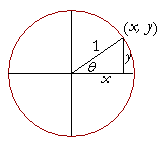
in this picture,
 = x)
and
 = y)
now we are trying to find when
 + cos(x) = 1)
, let us call

a point on the unit-circle.
Now, for sin(x) + cos(x) to equal 1, then the point is
)
because the x-coordinate of P represents
)
and the y-coordinate represents
)

Vector OP is the line from the origin to our point P and OP has length 1 (as this is the unit circle), so:
\vec{j})
now, dotting this vector with itself, we get:
^2)
And since we know

, then:
^2)
Expanding & simplifying & canceling, we get:
)
therefore:

so
will be true when our point is:
\mbox{ or }P(1, 0))
(which represent when cos(x) = 0 and sin(x) = 1 AND cos(x) = 1 and sin(x) = 0, respectively)
so these simplify to the two above equations which i gave

 Home
Home
 Help
Help
 Search
 Login
Login
