Login

Welcome, Guest. Please login or register.

April 27, 2026, 02:25:26 am

Author Topic: VCE Methods Question Thread!  (Read 6058742 times)  Share 

0 Members and 34 Guests are viewing this topic.

vcestressed

  • Guest
Re: VCE Methods Question Thread!
« Reply #14325 on: December 19, 2016, 12:05:34 pm »
0
thanks, good luck with your results tomorrow !!  :D

Jakeybaby

  • Trendsetter
  • **
  • Posts: 191
  • Grad Year: 2016
  • Respect: +23
Re: VCE Methods Question Thread!
« Reply #14326 on: December 19, 2016, 01:04:36 pm »
0

thanks, good luck with your results tomorrow !!  :D
Cheers, appreciate it
2016 ATAR: 98.60

2020: Bachelor of Finance @ University of Adelaide

Recipient of the 2017 University of Adelaide Principals' Scholarship

Izzy999

  • Adventurer
  • *
  • Posts: 12
  • Respect: +1
Re: VCE Methods Question Thread!
« Reply #14327 on: December 21, 2016, 04:14:04 pm »
0
Hey guys, could any of you help me with this question that I'm having trouble with?

Find the inverse function of each of the following:

f:R∖{3}→R, f(x)=1/(x−3)+1

I've found that the inverse is f^-1(x)=1/(x-1)+3, but the answers for the question say that f^-1(x)=3/(x-1)+2, but I'm not sure how that is.

Thanks!
« Last Edit: December 21, 2016, 04:26:53 pm by Izzy999 »
2016: Psych [42]
2017: Chem [43] Lit [41] Methods [36] Drama [31] Further [50]~ 98.2

RuiAce

  • ATAR Notes Lecturer
  • Honorary Moderator
  • Great Wonder of ATAR Notes
  • *******
  • Posts: 8814
  • "All models are wrong, but some are useful."
  • Respect: +2575
Re: VCE Methods Question Thread!
« Reply #14328 on: December 21, 2016, 04:18:04 pm »
0
Hey guys, could any of you help me with this question that I'm having trouble with?

Find the inverse function of each of the following:

f:R∖{3}→Rf:R∖{3}→R , f(x)=1x−3+1

I've found that the inverse is f^-1(x)=(1/x-1)+3, but the answers for the question say that f^-1(x)=(3/x-1)+2, but I'm not sure how that is.

Thanks!
Look at your question. You accidentally typed the domain and codomain twice however you're definitely missing a fraction sign there. And your brackets look misplaced for the answers.

If you want to communicate \(\frac{1}{x-1} +3\) you write it as 1/(x-1)+3

Izzy999

  • Adventurer
  • *
  • Posts: 12
  • Respect: +1
Re: VCE Methods Question Thread!
« Reply #14329 on: December 21, 2016, 04:24:48 pm »
0
Look at your question. You accidentally typed the domain and codomain twice however you're definitely missing a fraction sign there. And your brackets look misplaced for the answers.

If you want to communicate \(\frac{1}{x-1} +3\) you write it as 1/(x-1)+3

Oh whoops, sorry about that. I didn't double check correctly when I typed up my question, obviously. Thanks
2016: Psych [42]
2017: Chem [43] Lit [41] Methods [36] Drama [31] Further [50]~ 98.2

RuiAce

  • ATAR Notes Lecturer
  • Honorary Moderator
  • Great Wonder of ATAR Notes
  • *******
  • Posts: 8814
  • "All models are wrong, but some are useful."
  • Respect: +2575
Re: VCE Methods Question Thread!
« Reply #14330 on: December 21, 2016, 04:32:52 pm »
0
Image is too large on desktop

Wolfram agrees, so unless there is a typo they are wrong.

Edit: A typo is likely, because if I re-invert their answer I get 1/(x-2)+1
Image is too large on desktop
« Last Edit: December 21, 2016, 04:58:00 pm by RuiAce »

Izzy999

  • Adventurer
  • *
  • Posts: 12
  • Respect: +1
Re: VCE Methods Question Thread!
« Reply #14331 on: December 21, 2016, 04:51:42 pm »
0
Ah okay, thank you!
2016: Psych [42]
2017: Chem [43] Lit [41] Methods [36] Drama [31] Further [50]~ 98.2

deStudent

  • Trendsetter
  • **
  • Posts: 193
  • Respect: 0
Re: VCE Methods Question Thread!
« Reply #14332 on: December 21, 2016, 05:06:08 pm »
0
Hi guys, got 2 questions I need help on http://m.imgur.com/a/6JhU7

For the first image, is anyone else not getting what the answer has when using a Ti-Nspire? I'm getting x = -(k-mx-4) / 2(m-2) and y = k-mx / 2. I get what the answer has with my classpad but I plan on using the Ti in the exam.

For Q5, I don't quite understand the alternative method shown using matrices. More specifically lines 2 and 3. In line 2 how'd they get that matrix and why is it equal to 0. For line 3, how'd they get 15 - 2m - m^2?

Syndicate

  • Forum Leader
  • ****
  • Posts: 797
  • Hard work beats Talent
  • Respect: +139
Re: VCE Methods Question Thread!
« Reply #14333 on: December 22, 2016, 11:25:22 am »
+1
Hi guys, got 2 questions I need help on http://m.imgur.com/a/6JhU7

For the first image, is anyone else not getting what the answer has when using a Ti-Nspire? I'm getting x = -(k-mx-4) / 2(m-2) and y = k-mx / 2. I get what the answer has with my classpad but I plan on using the Ti in the exam.

It works fine for me.Try inserting multiplication signs in front of every coefficient of x and y. 

Personally I hate the book's method and would rather equate the gradient of both equations in order to calculate when they are both equal.

My approach:

So now we know that there are either no solutions or infinitely many solutions when m = 4.

a) \(m \space \epsilon \space \mathbb{R} \text { \ {4}} \) and \( k \space \epsilon \space \mathbb{R} \)

b)  \( c_1 = c_2 \\ \frac{k}{2} = 2 \\ \therefore k  = 4 \) However the question says to work out the value(s) of m and k, when there would be no solutions. Which means \( m_1 = m_2 \space \text{and} \space c_1 \neq c_2 \)

Therefore m = 4 and \( k \neq 4\)

c) The two equations must be a scalar multiple of one another. Therefore \( m_1 = m_2 \space \text{and} \space c_1 = c_2\)

m = 4 and k = 4

For Q5, I don't quite understand the alternative method shown using matrices. More specifically lines 2 and 3. In line 2 how'd they get that matrix and why is it equal to 0. For line 3, how'd they get 15 - 2m - m^2?

I would suggest looking at cramer's rule.

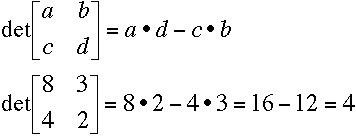
Line 2 : [Seems like they made a mistake. Row 2, column 2 must be 5] They have let it equal to zero, in order to work out the determinant of the matrix. A determinant of 0 corresponds to parallel lines (with either infinitely many solutions or no solutions), and a non-invertible matrix.


In line 3: they have worked out the determinant of the matrix.
2017: Chemistry | Physics | English | Specialist Mathematics | Mathematics Methods
2018-2020 : Bachelor of Biomedicine at University of Melbourne

Physics Guide 2017

deStudent

  • Trendsetter
  • **
  • Posts: 193
  • Respect: 0
Re: VCE Methods Question Thread!
« Reply #14334 on: December 22, 2016, 12:02:08 pm »
0
It works fine for me.Try inserting multiplication signs in front of every coefficient of x and y. 

Personally I hate the book's method and would rather equate the gradient of both equations in order to calculate when they are both equal.

My approach:

So now we know that there are either no solutions or infinitely many solutions when m = 4.

a) \(m \space \epsilon \space \mathbb{R} \text { \ {4}} \) and \( k \space \epsilon \space \mathbb{R} \)

b)  \( c_1 = c_2 \\ \frac{k}{2} = 2 \\ \therefore k  = 4 \) However the question says to work out the value(s) of m and k, when there would be no solutions. Which means \( m_1 = m_2 \space \text{and} \space c_1 \neq c_2 \)

Therefore m = 4 and \( k \neq 4\)

c) The two equations must be a scalar multiple of one another. Therefore \( m_1 = m_2 \space \text{and} \space c_1 = c_2\)

m = 4 and k = 4

I would suggest looking at cramer's rule.

Line 2 : [Seems like they made a mistake. Row 2, column 2 must be 5] They have let it equal to zero, in order to work out the determinant of the matrix. A determinant of 0 corresponds to parallel lines (with either infinitely many solutions or no solutions), and a non-invertible matrix.


In line 3: they have worked out the determinant of the matrix.

(Image removed from quote.)
Thanks for the help again!

deStudent

  • Trendsetter
  • **
  • Posts: 193
  • Respect: 0
Re: VCE Methods Question Thread!
« Reply #14335 on: December 22, 2016, 10:36:06 pm »
0
Soz, one more question  :P

http://m.imgur.com/a/0nJ0i

For Q7) I seem to be missing a solution (m = 0). The method which I used was equating the gradients and solving for m, and then subbing them back in. I got m=4 (infinite sols) and m=-2 (no sols). I didn't get m = 0 which was the solution for part (b).

Why does my method not give all 3 solutions? I also tried subbing equation 1 in to eqn 2, but I still only got 2 solutions.

My answer for part b was: x = 4/m+2, y = 2(m+4)/m+2, where m = R except {-2,4}. Is this wrong? The book's answer didn't write the answer in terms of m, they just subbed in 0 and solved.

Q8) So I solved this and got y(-2k-3) = 0 and thus y = 0, but the answer included next to this 'k =/= -3/2'. I didn't realise this until part (b) where this was the answer. How do I recognise that I need to write that part about k, in part (a)?

Thanks

Guideme

  • Forum Regular
  • **
  • Posts: 87
  • Help me get the ATAR i want! :)
  • Respect: 0
Re: VCE Methods Question Thread!
« Reply #14336 on: December 23, 2016, 05:44:55 pm »
0
Consider the Functions f:R--->R, f(x)=x^2-4 and g:R+U{0} --->R,g(x)=square root x      (Also: x ^(1/2))
 Explain why g(f(x)) does not exist
:0 :)

Syndicate

  • Forum Leader
  • ****
  • Posts: 797
  • Hard work beats Talent
  • Respect: +139
Re: VCE Methods Question Thread!
« Reply #14337 on: December 23, 2016, 05:53:25 pm »
+2
Consider the Functions f:R--->R, f(x)=x^2-4 and g:R+U{0} --->R,g(x)=square root x      (Also: x ^(1/2))
 Explain why g(f(x)) does not exist

ran f must be a subset of dom g

domain of g(x) is \( \mathbb{R}^+ U \text{ {0} } \) and the range of f(x) is [-4, infinity). This means range of f(x) is not a subset of the domain of g(x), since it is larger.

Since range of f(x) is not a subset of the domain of g(x), g(f(x)) cannot exist.

Soz, one more question  :P

http://m.imgur.com/a/0nJ0i

For Q7) I seem to be missing a solution (m = 0). The method which I used was equating the gradients and solving for m, and then subbing them back in. I got m=4 (infinite sols) and m=-2 (no sols). I didn't get m = 0 which was the solution for part (b).

Why does my method not give all 3 solutions? I also tried subbing equation 1 in to eqn 2, but I still only got 2 solutions.

My answer for part b was: x = 4/m+2, y = 2(m+4)/m+2, where m = R except {-2,4}. Is this wrong? The book's answer didn't write the answer in terms of m, they just subbed in 0 and solved.

a) The lines are only parallel when m = -2, 4. When m = 0, it returns a unique solution, which means 0 must be discarded. Regardless of what method the book has used, the only two correct solutions for m will be -2 and 4.

b) Once again, there are multiple methods to solve this question. Your method should be completely fine (unless stated to use a specific method), as long as you get the correct answers.
Q8) So I solved this and got y(-2k-3) = 0 and thus y = 0, but the answer included next to this 'k =/= -3/2'. I didn't realise this until part (b) where this was the answer. How do I recognise that I need to write that part about k, in part (a)?

I guess it doesn't really matter since the question hasn't stated for you to write the values for k. It has only asked you to work out the values for y and x. So, if you don't write it on the exam, you shouldn't exactly lose marks (please do confirm this one).
« Last Edit: December 23, 2016, 06:07:04 pm by Syndicate »
2017: Chemistry | Physics | English | Specialist Mathematics | Mathematics Methods
2018-2020 : Bachelor of Biomedicine at University of Melbourne

Physics Guide 2017

samuelbeattie76

  • Adventurer
  • *
  • Posts: 24
  • Obsessed with improvement
  • Respect: 0
Re: VCE Methods Question Thread!
« Reply #14338 on: December 28, 2016, 03:54:09 am »
0
I have attached a screenshot I need help with questions b and c. Any help is greatly appreciated. Thank you.

nyggfany

  • Adventurer
  • *
  • Posts: 14
  • Respect: 0
Re: VCE Methods Question Thread!
« Reply #14339 on: December 28, 2016, 04:36:45 am »
0